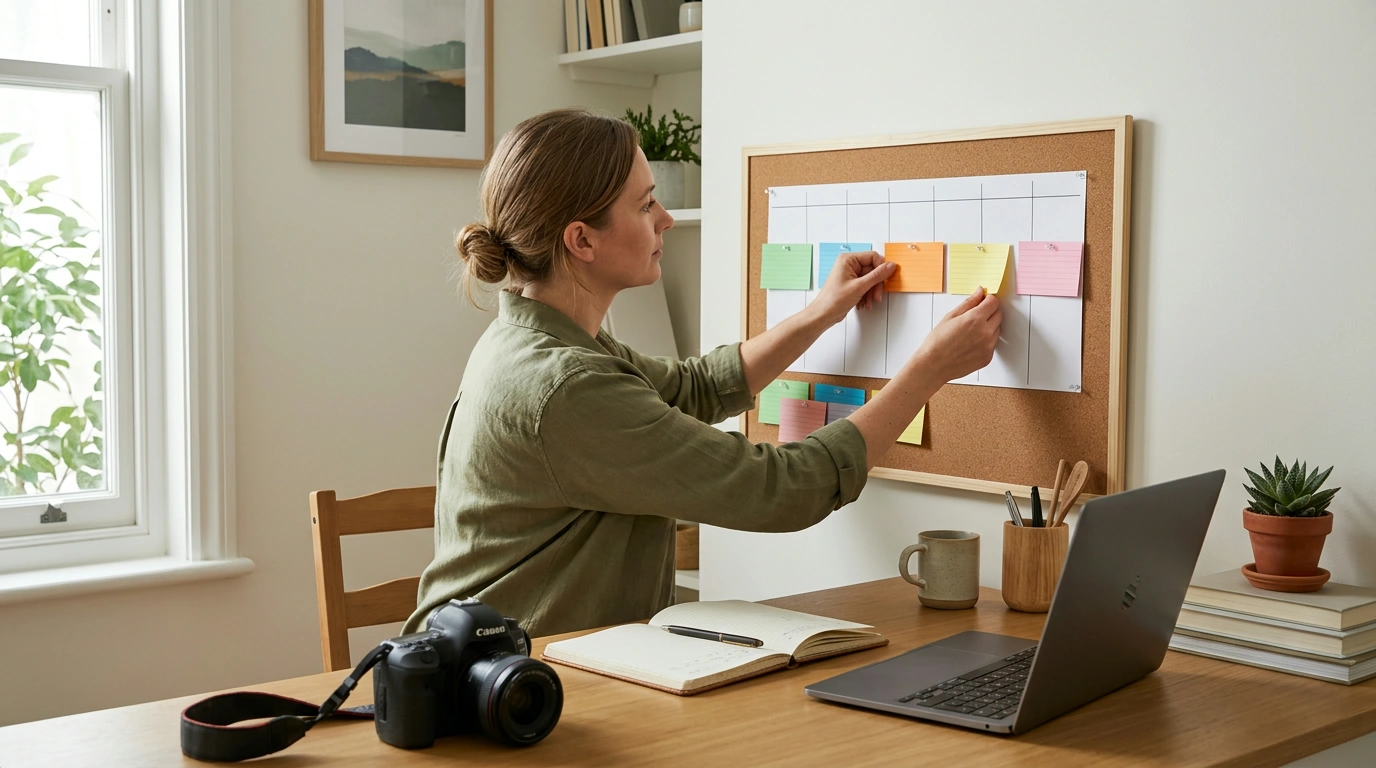
Posting consistently can feel harder than creating the content itself. A repeatable rhythm turns “what should be posted today?” into a predictable set of steps: plan, batch, publish, and review. The result is less decision fatigue, fewer last-minute scrambles, and a steadier level of quality—even when schedules get busy.
If you want a straightforward system you can run week after week, the steps below break a posting rhythm into practical phases that fit real life and make it easier to keep showing up.
A posting rhythm is a repeatable schedule that matches your available time, your audience’s expectations, and the effort your content requires. Instead of relying on motivation, a rhythm works because it pre-decides the basics—what you post, when you post, and how you’ll produce it.
When themes, formats, and publishing windows are already chosen, you spend less mental energy deciding and more energy creating. A rhythm also protects quality by spreading the workload across the week, so you’re not trying to write, film, and publish everything under pressure. The goal is sustainable momentum: fewer gaps, fewer bursts, and clearer priorities.
Start with a frequency you can maintain for 8–12 weeks without burnout. For many small teams and solo creators, that looks like 3 short posts plus 1 longer post per week. If that feels heavy, cut it in half—consistency beats volume.
Next, define publishing windows (morning/afternoon/evening) based on when your audience is most likely to engage. Pair that with two consistent work blocks: one for planning (30–60 minutes) and one for batching (1–3 hours). Keeping these blocks on the calendar is what turns “someday” content into a reliable habit (see the APA’s definition of habit for a helpful lens on repetition and cues: https://dictionary.apa.org/habit).
Finally, decide what “counts” as a post—photo, short video, carousel, story, newsletter, or blog entry. This removes ambiguity on busy days.
Choose 3–5 content pillars you can talk about endlessly without forcing creativity. Common pillars include how-to education, behind-the-scenes, product use cases, customer stories, and quick tips.
Then assign repeating weekly themes to reduce ideation load. For example: Monday tip, Wednesday tutorial, Friday roundup. You’re not locking yourself into a cage—you’re giving yourself rails so you can move faster.
Keep production simple by standardizing 2–3 formats that are easy to make: template-based checklists, talking-head clips, and short “problem → fix” posts. Store every idea in a backlog and tag it by pillar + format so it can be scheduled quickly during planning.
Weekly planning works best when it’s fast. Start with a single objective: educate, drive sign-ups, highlight a product, or answer a common question. If you like frameworks, setting a SMART-style objective can keep decisions tight (https://www.mindtools.com/a4wo118/smart-goals).
| Day | Post type | Approx. effort | Goal | Asset needed |
|---|---|---|---|---|
| Mon | Quick tip / checklist | 20–30 min | Awareness | Template graphic |
| Wed | How-to tutorial | 60–90 min | Education | Photos or short clips |
| Fri | Proof / story (review, case, before-after) | 30–45 min | Trust | Customer quote or example |
| Sun | Roundup / recap + next week teaser | 20–40 min | Retention | Links + notes |
Use a consistent structure to speed up writing: hook → value → proof/example → next step. Then prepare lightweight variations so each idea can travel across channels without rework (short/long caption, square/vertical crop, or a version that becomes a newsletter paragraph). If you want broader platform guidance, HubSpot’s overview is a solid reference: https://blog.hubspot.com/marketing/social-media-marketing.
If you create kitchen or home content, a tidy, repeatable background makes visuals look cohesive without extra work. A neutral tabletop paired with a distinctive prop can become your signature look—try something like the Scandinavian Handwoven Leaf Placemat – Eco-Friendly Straw Dining Mat for texture, or a hero dish moment using the Handmade Ceramic Noodle Bowl – Creative Round Ramen Soup Deep Bowl. When your setup is repeatable, batching gets faster and your feed looks more intentional.
If you want a simple reference you can keep open while planning and batching, Posting Rhythm Steps can serve as a lightweight guide to keep your cadence organized. The goal isn’t more complexity—it’s fewer decisions and smoother follow-through.
Choose a cadence you can sustain for 8–12 weeks. Low bandwidth might be 1–2 posts per week, medium bandwidth 3–4, and high bandwidth 5–7; consistent delivery matters more than posting a high volume.
No—use a fallback post if needed, or simply publish in the next slot without doubling your workload. Treat the miss as a signal for your weekly review so you can fix the cause rather than “catch up” aggressively.
Planning one week ahead is a solid baseline, with batching 1–2 weeks when your schedule allows. Keep at least one flexible slot open so you can publish timely updates without breaking the rhythm.










Leave a comment