
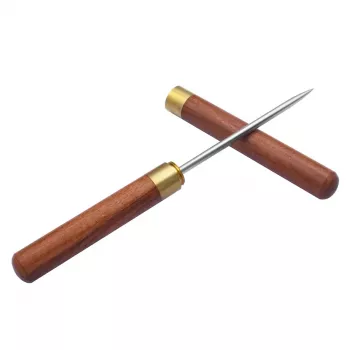
Some kitchen tools earn their keep by doing one job exceptionally well. A solid ice pick is one of them—especially when you want cleaner cracks, faster drainage channels, or a reliable way to break down stubborn ice without hammering your countertop. Our stainless steel ice pick pairs a sharp, narrow point with a protective safety cover and a wooden non-slip handle, giving you control for everyday home bar tasks and a handful of practical kitchen jobs.
If you’ve ever tried to “fix” oversized cubes by smashing them, you already know the downside: icy snow, flying chips, and unpredictable results. An ice pick is about targeted pressure and guided cracks.
An ice pick doesn’t need to be complicated—but a couple of design choices make it easier to use consistently and store with fewer worries.
Good technique is what makes an ice pick feel precise instead of risky. Our team uses a short, controlled rhythm—never long, stabbing motions.
For general tool-safety principles (like controlling the work surface and keeping hands out of the line of force), OSHA’s guidance on hand and power tools is a helpful baseline—even for small kitchen tools.
There’s a reason many bars keep an ice pick within reach: it’s adaptable. You can split one cube, free a frozen cluster, or shape ice a bit for a single drink without setting up extra equipment.
| Task | Best option | Why |
|---|---|---|
| Split a few cubes for cocktails | Ice pick | Clean, controlled cracks with minimal shattering |
| Crush a lot of ice quickly | Mallet + ice bag | Speed for high volume (more碎 ice and mess) |
| Break fused freezer ice clumps | Ice pick | Leverage and precision without hacking |
| Fine shaved ice texture | Dedicated crusher/shaver | Consistent texture (less versatile, more storage) |
A chef’s knife shouldn’t be your substitute here: stabbing or prying with a knife risks slips and blade damage. When you’re handling ice as something you’ll serve and consume, sanitation matters, too—especially if you’re moving ice between bins, bags, and coolers. The FDA Food Code lays out general handling and cleanliness principles that translate well to home entertaining.
A little routine care keeps the tool feeling the same in your hand every time.
Yes, when the point is fully dry and covered with the safety cover; place it tip-forward in a separate section or utensil tray so the cover stays on and hands don’t brush the point.
It can handle small piercing/starting-hole tasks where a narrow point helps, but it should be used on stable surfaces with controlled pressure; avoid using it as a screwdriver, chisel, or pry bar for hard materials that can slip.
Dry it after washing and avoid soaking; if it feels dry, wipe with a small amount of food-safe mineral oil and buff off excess to maintain a comfortable, non-slip feel.










Leave a comment